As blockchain, AI, and Web3 reshape the future of work, millions of people with disabilities across the continent face a stark choice: adapt without support or be excluded entirely. A growing movement of leaders is demanding a third option.
By Times of Fortune Editorial Team
The numbers tell a story that most innovation summits, tech conferences, and corporate strategy sessions never hear.
One billion people worldwide—approximately 15 percent of the global population—live with some form of disability. In Africa, the figure is estimated at 80 to 100 million, though reliable data remains scarce, itself a symptom of the invisibility that characterizes the disability experience on the continent. Of those, the World Health Organization estimates that fewer than 10 percent have access to the assistive technologies they need, and employment rates for people with disabilities in sub-Saharan Africa hover between 1 and 3 percent in the formal sector.
Now, layer onto this reality the fastest technological transformation in human history.
Artificial intelligence is automating jobs, creating new roles, and demanding digital fluency as a baseline for economic participation. Blockchain technology is restructuring financial systems, supply chains, and organizational governance. Web3 promises decentralized, transparent, and participatory digital ecosystems. The Fourth Industrial Revolution, we are told, will create 97 million new jobs by 2025 and displace 85 million others.
But for millions of people with disabilities across Africa—people who are blind, deaf, physically impaired, neurodiverse, or living with chronic conditions—this revolution risks becoming the greatest exclusion event in modern economic history.
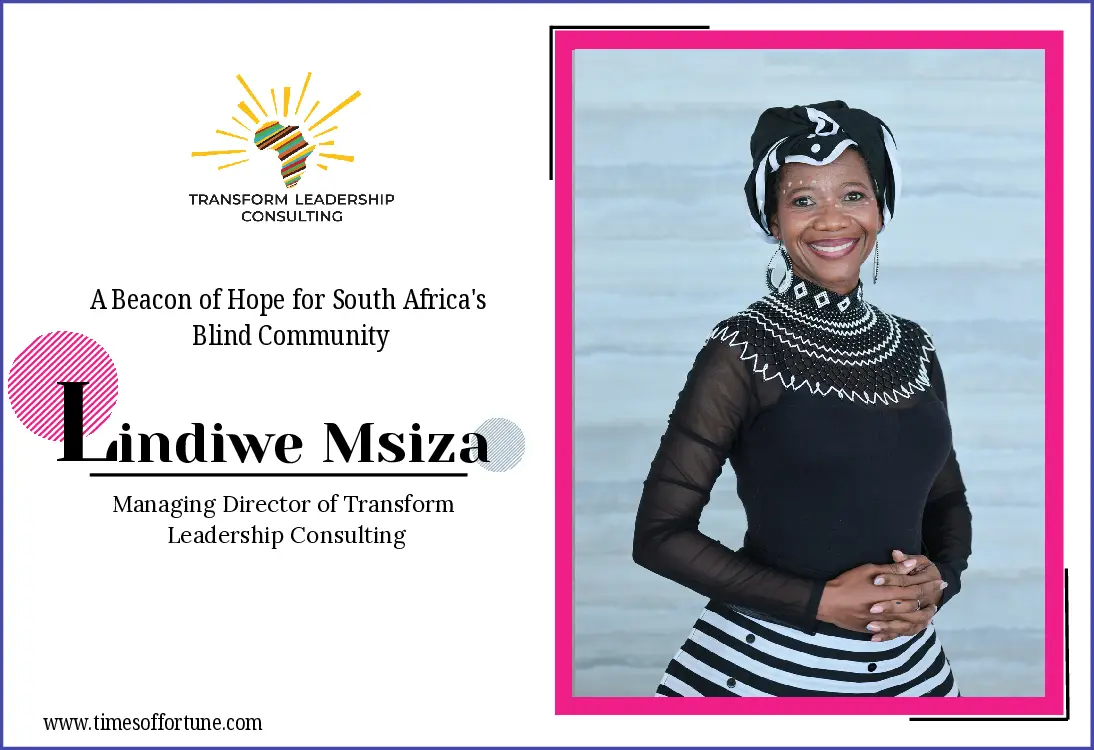
"While innovators move with urgency, marginalized communities risk being left behind," warns Lindiwe Msiza, Managing Director of Transform Leadership Consulting and this month's Times of Fortune cover subject. "People who are blind, deaf, or differently abled are often excluded from creative and strategic spaces, relying heavily on caregivers to access technology. Leadership in the age of AI and Web3 must balance speed and innovation with inclusion and equity, ensuring that no one is left out of shaping the future."
For Lindiwe, this is not an abstract policy concern. It is deeply, painfully personal.
A SISTER'S STORY
Siphiwe Esther Lindiwe worked for a prominent South African company for ten years. She was competent, committed, and valued. Then she lost her sight.
"The workplace was unprepared for such life-changing circumstances," Lindiwe recalls. "There were no systems in place to anticipate, protect, or support employees facing sudden disability. My sister's experience exposed a gap that exists in organizations across the continent and around the world."
That experience became the catalyst for Lindiwe's "A Nation of Light" initiative and her partnership with Speccon Consulting to launch Tap Passport to Work—an education platform designed to place learning and workforce readiness at the fingertips of every learner, regardless of location or ability.
But Siphiwe's story is far from unique. Across Africa, employees who acquire disabilities during their careers—through accidents, illness, or age-related conditions—routinely face termination, demotion, or forced early retirement. Those born with disabilities face barriers at every stage: from inaccessible schools to discriminatory hiring practices, from physical infrastructure that excludes wheelchair users to digital platforms that cannot be navigated by screen readers.
The result is a vast reservoir of untapped human potential—talent, creativity, and leadership that organizations cannot afford to waste.

THE ECONOMIC IMPERATIVE
The moral case for disability inclusion is self-evident. But the economic case is equally compelling—and increasingly impossible to ignore.
The International Labour Organization (ILO) estimates that the exclusion of people with disabilities from the labor market costs developing economies between 3 and 7 percent of GDP annually. In Africa, where youth unemployment already exceeds 60 percent in some countries and demographic projections indicate that the continent's working-age population will double by 2050, the failure to include people with disabilities in the workforce is not just unjust—it is economically catastrophic.
Research by Accenture's 2023 "Getting to Equal" study found that companies that actively champion disability inclusion achieve, on average, 28 percent higher revenue, 30 percent higher profit margins, and double the net income of their peers. The Return on Disability Group estimates the global disability market at $13 trillion in annual disposable income—a consumer base larger than China's.
"This is not only a social issue—it is an economic and moral imperative," Lindiwe emphasizes. "By 2030, millions of workers from marginalized populations—including those living with disabilities—will face barriers in education, employment, and economic participation. Without deliberate interventions, emerging technologies risk widening inequality, leaving the most vulnerable even further behind."
THE TECHNOLOGY PARADOX
Technology has always been a double-edged sword for people with disabilities. On one hand, assistive technologies—screen readers, hearing aids, prosthetics, voice recognition software, and adaptive interfaces—have opened doors that were previously sealed shut. The smartphone revolution placed more assistive capability in a single device than entire rehabilitation centers possessed a generation ago.
On the other hand, the accelerating pace of technological change creates new barriers as quickly as it removes old ones. Consider:
Artificial Intelligence: While AI-powered tools like natural language processing, computer vision, and predictive text hold enormous promise for accessibility, many AI systems are trained on datasets that exclude or underrepresent people with disabilities. The result is algorithms that perpetuate bias, voice assistants that cannot understand non-standard speech patterns, and hiring platforms that screen out candidates with employment gaps caused by disability.
Blockchain and Web3: Decentralized platforms promise financial inclusion and transparent governance, but most blockchain interfaces are designed for sighted, technically literate users. Wallet management, smart contract interaction, and DAO (Decentralized Autonomous Organization) participation require digital fluency that many people with disabilities have never had the opportunity to develop—not because of incapacity, but because of inaccessible education systems.
Remote Work: The post-pandemic shift to remote work has been celebrated as a boon for disability inclusion, eliminating commuting barriers and offering flexible schedules. Yet remote work also assumes reliable internet access, appropriate home workspaces, and digital skills—assumptions that do not hold for millions of people with disabilities in Africa, where connectivity remains uneven and assistive technology scarce.
"The question is not whether technology can include people with disabilities," says Dr. Kudakwashe Dube, disability rights researcher at the University of Cape Town. "It can, and it does. The question is whether those designing and deploying technology are willing to invest the time, resources, and intentionality required to make inclusion the default rather than the afterthought."
BUILDING BRIDGES: INNOVATION MEETS INCLUSION
Across Africa, a growing ecosystem of organizations, entrepreneurs, and advocates is working to ensure that the innovation revolution does not become an exclusion revolution.
Tap Passport to Work
Launched through the partnership between Transform Leadership Consulting and Speccon Consulting, Tap Passport to Work represents a new model for accessible workforce readiness. The platform equips young people with skills, awareness, and opportunities regardless of location or ability, while addressing the realities of forced migration and transnational movement.
"We are building a workforce that is inclusive, resilient, and ready to transcend borders," Lindiwe explains. "Ensuring that innovation benefits all, not just the privileged few."
inABLE (Kenya)
This Nairobi-based organization has established computer labs equipped with assistive technology in schools for the blind across Kenya, providing students with digital literacy skills and opening pathways to employment in the technology sector. Since its founding, inABLE has trained thousands of young people who are blind or visually impaired, many of whom have gone on to careers in software development, data analysis, and digital content creation.
Disability:IN Africa Initiative
Modeled on the successful Disability:IN network in the United States, this emerging initiative connects multinational corporations operating in Africa with disability inclusion best practices, accessible workplace design standards, and talent pipelines that include people with disabilities.
SignLive Africa
A growing network of sign language interpretation platforms is making digital communication accessible to deaf communities across the continent. By integrating real-time sign language interpretation into video conferencing, customer service, and educational platforms, these services are breaking down barriers that have historically excluded deaf individuals from full economic participation.
The African Disability Forum
This pan-African advocacy organization works to ensure that disability rights are integrated into the African Union's Agenda 2063—the continent's blueprint for sustainable development. Their advocacy has been instrumental in pushing for accessible infrastructure, inclusive education policies, and employment quotas in several African nations.
THE POLICY LANDSCAPE
Africa's policy framework for disability inclusion is a patchwork of progressive legislation and patchy implementation.
South Africa's Employment Equity Act sets a target of 2 percent representation of people with disabilities in the workforce—a target that most organizations consistently fail to meet. The country's Constitution explicitly prohibits discrimination on the basis of disability, and the White Paper on the Rights of Persons with Disabilities (2015) provides a comprehensive framework for inclusion across all sectors.
Kenya's Persons with Disabilities Act mandates a 5 percent employment quota in both public and private sectors, though enforcement remains weak. Rwanda, often cited as a continental leader in inclusive governance, has integrated disability considerations into its national development strategy and established a National Council of Persons with Disabilities with genuine policy influence.
The African Union's Protocol to the African Charter on Human and Peoples' Rights on the Rights of Persons with Disabilities, adopted in 2018, provides a continental framework—but ratification and implementation remain slow.
"Legislation is necessary but insufficient," observes Lindiwe. "Real change requires mindset shifts, cultural transformation, and leaders who are willing to see people with disabilities not as beneficiaries of charity but as contributors to innovation, growth, and national prosperity."
LESSONS FROM THE COVER STORY
Lindiwe Msiza's career offers a blueprint for how organizations can move from exclusion to inclusion—not through compliance-driven checkbox exercises but through genuine cultural transformation.
Her Ubuntu-centered approach—seeing the person before the role, creating intentional moments of connection, embedding values into daily practice—applies directly to disability inclusion. When organizations adopt the principle that every person deserves to be seen, heard, and empowered, the question shifts from "How do we accommodate people with disabilities?" to "How do we design systems, cultures, and technologies that work for everyone?"
Her experience with the Amakhwezi program at SARS demonstrates that recognition and empowerment drive engagement more effectively than mandates and quotas. Her Relationships by Objectives (RBO) methodology shows that even the most entrenched divisions—between management and unions, between the abled and disabled, between innovators and the marginalized—can be bridged through intentional dialogue, mutual respect, and shared purpose.
And her "A Nation of Light" initiative offers a vision for what disability inclusion could look like at scale: a global network of light bearers—leaders, innovators, funders, and volunteers—working together to ensure that no one is left in darkness.
WHAT ORGANIZATIONS CAN DO NOW
For leaders and organizations seeking to move from performative inclusion to genuine disability integration, experts recommend the following immediate actions:
1. Conduct an Accessibility Audit
Evaluate every touchpoint of the employee and customer experience—from recruitment processes and digital platforms to physical infrastructure and communication channels—for accessibility barriers. Engage people with disabilities as auditors, not just subjects.
2. Invest in Assistive Technology
Ensure that employees with disabilities have access to the tools they need to perform at their best. This includes screen readers, voice recognition software, ergonomic equipment, captioning services, and sign language interpretation. The cost is typically modest; the return—in loyalty, engagement, and productivity—is substantial.
3. Design for Universal Access
Adopt universal design principles that create products, services, and environments usable by the widest possible range of people without the need for adaptation. What works for people with disabilities invariably works better for everyone.
4. Build Inclusive Leadership Capability
Train leaders to understand disability as a dimension of diversity, to recognize and challenge their own biases, and to create psychologically safe environments where employees with disabilities feel empowered to contribute fully and request accommodations without stigma.
5. Establish Disability Employee Resource Groups
Create spaces where employees with disabilities and their allies can share experiences, advocate for systemic change, and contribute to organizational policy development.
6. Partner with Disability Organizations
Collaborate with organizations like inABLE, the African Disability Forum, and Transform Leadership Consulting's Tap Passport to Work to access talent, expertise, and best practices.
7. Measure and Report
Track disability representation, retention, and advancement metrics with the same rigor applied to other business KPIs. Publish results transparently and hold leadership accountable for progress.
THE LIGHT AHEAD
The convergence of demographic change, technological transformation, and growing social consciousness creates a unique window of opportunity for Africa's disability inclusion movement.
The continent's youthful population—median age 19, compared to 38 in Europe and 31 in Asia—means that investments in accessible education and workforce readiness today will yield returns for decades. The rapid expansion of mobile connectivity, which has already leapfrogged traditional infrastructure in banking, healthcare, and education, offers a platform for delivering assistive technologies and inclusive learning at scale. And the growing global emphasis on Environmental, Social, and Governance (ESG) standards is creating market incentives for companies that demonstrate genuine commitment to inclusion.
But none of this will happen automatically. It requires the kind of intentional, courageous, faith-driven leadership that Lindiwe Msiza embodies—leadership that sees every person as a bearer of light, that refuses to accept exclusion as inevitable, and that builds systems designed not for the few but for all.
"My legacy is clear and unwavering," Lindiwe declares. "I envision a world where women and children are safe, the marginalized are fully included in innovation, and every workplace and community thrives on LOVE, purpose, and unity."
In that vision lies a challenge to every organization, every leader, and every innovator on the continent and beyond: Will you be a light bearer, or will you look away?
The choice, as always, is ours.
Because we are because of each other—and our future depends on remembering that.
Ecosystem of Impact | Resources, Partners & Next-Generation Initiatives
Leadership, Governance & Systems Change
-
Transform Leadership Consulting — Leadership development, organisational effectiveness, strategy facilitation, and change management consulting.
Website: https://transformleadershipconsulting.com/
-
Global Women in Leadership Summit — 2026 Edition is called SHOWUPandLead A global leadership platform advancing women’s influence, governance, and systems impact.
Website: https://www.showupandlead.com/
Podcast on Spotify: Let’s Talk — Bring Your Chair to the Table
-
Women Making Change NPC — A non-profit organisation founded by Lindiwe Msiza, advancing women’s leadership, advocacy, and social impact.
Disability Inclusion & Advocacy
(Aligned with A Nation of Light)
-
Blind SA — Championing dignity, independence, and inclusion for blind and partially sighted persons across South Africa. Website: https://blindsa.org.za/donate/
-
South African Council for the Blind — Delivering development programmes and services that empower blind and visually impaired communities nationwide. Website: https://sancb.org.za/
-
African Disability Forum — A pan-African platform advocating for disability rights, inclusion, and policy influence.
-
inABLE — Advancing digital literacy and assistive technology access for blind and visually impaired youth in Kenya.
Faith & Community Anchor
-
Gracepoint Methodist Church — A central convening and pilot site for A Nation of Light fundraising, mobilisation, and community-led impact initiatives. Website: https://gracepoint.co.za
Health, Care & Innovation
-
HomeCare Connect — An end-to-end homecare application empowering homecare professionals and ensuring quality patient care across the African continent.
Next-Generation Initiatives
-
ThrivePro — A pathway to possibilities for CTA and CA(SA) students, supporting academic success, professional readiness, and leadership development - Website: https://thrivepro.co.za
-
Tap Passport to Work — An e-learning education and workforce-readiness platform enabling inclusive access to employment opportunities; a growing initiative expanding economic participation.