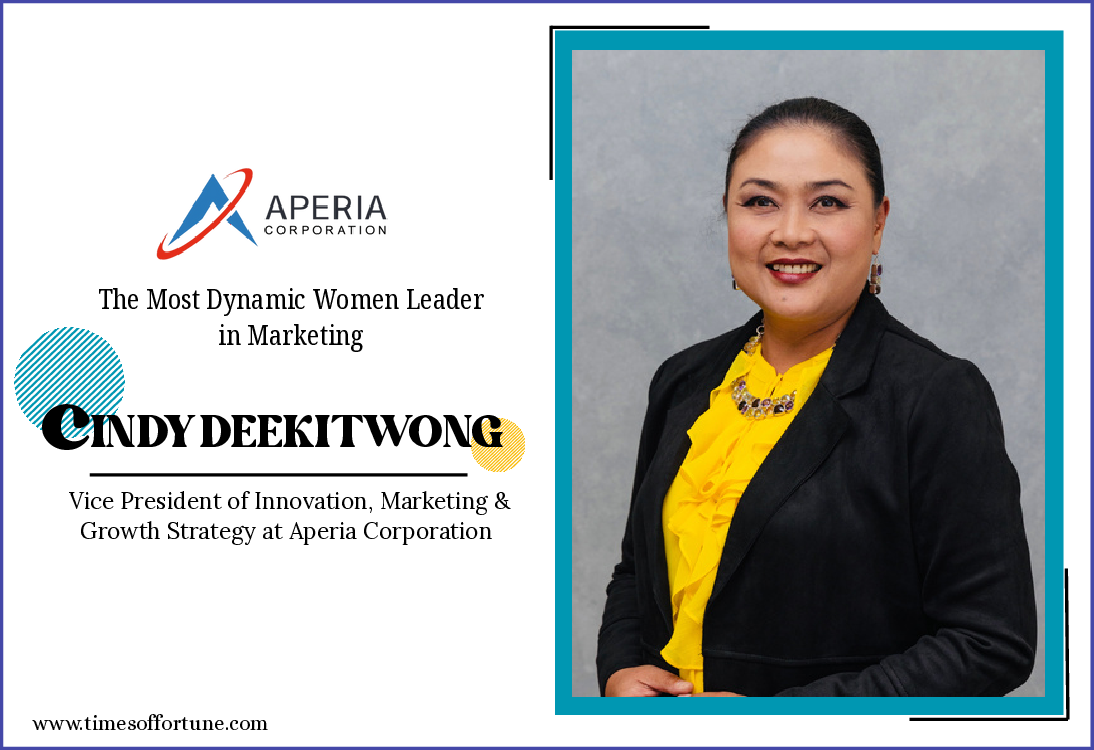
CINDY DEEKITWONG
Building Bridges Between Innovation and Impact
By Times of Fortune Editorial Staff
In a world where the lines between technology and commerce grow increasingly blurred, few leaders possess the rare ability to navigate both with equal mastery. Cindy Deekitwong, Vice President of Innovation, Marketing & Growth Strategy at Aperia Corporation, is one of those exceptional leaders—a trailblazer whose nearly three-decade career has taken her from semiconductor clean rooms in Thailand to boardrooms in Tokyo, and from engineering labs to global marketing leadership.
Her philosophy is disarmingly simple yet profoundly effective: "Innovation only matters if it works at scale—and if people can execute it."
It's a principle forged not in business school case studies, but on the manufacturing floor, where Deekitwong began her career as a Process & Design Engineer at Microchip (Alphatec) Technology. There, amid the precision-demanding world of semiconductor packaging, she learned the foundational truth that would guide her entire career: great ideas are worthless without reliable execution.
The Making of a Bridge-Builder
Deekitwong's journey is a masterclass in intentional growth. From her early engineering days, she moved through progressively expansive roles at National Semiconductor and then Henkel, where she spent more than two decades transforming herself from technical specialist to global commercial leader.
"Each transition pushed me out of my comfort zone," she reflects. "Moving from technical depth to customer-facing roles, and eventually into global leadership."
What makes her career trajectory remarkable isn't just its breadth—spanning engineering, sales, operations, and marketing—but her deliberate integration of each discipline into a cohesive leadership approach.
"Engineering taught me discipline. Operations taught me execution. Sales taught me empathy for customers. Marketing taught me storytelling and scale," she explains. "Innovation, for me, lives at the intersection of all four."
This intersection is where Deekitwong thrives, serving as what she calls "the bridge"—connecting engineers with customers, innovation teams with commercial leaders, and global strategy with local execution.
A Global Perspective, Forged Across Continents
Working across Thailand, Japan, Germany and the United States hasn't just given Deekitwong geographic breadth—it has cultivated a nuanced understanding of how different cultures approach business, innovation, and leadership.
"In Thailand, I learned speed and entrepreneurship," she recounts. "In Japan, I learned precision, respect, and operational excellence. In the U.S., I learned how to scale ideas and lead through influence."
Her tenure as Supply Chain, Procurement & Operations Director in Japan proved particularly transformative. There, she achieved €6.5 million in cost savings while improving supply chain operation efficiency to over 95%—results that reinforced her conviction that commercial success is built on operational credibility.
"Japan reinforced a simple truth: commercial success depends on supply chain reliability," she notes. "Growth without operational excellence is fragile—and the best commercial leaders understand both."
This insight, combined with executive education in supply chain management from MIT, has made her uniquely equipped to speak the language of both the factory floor and the executive suite.
Two Decades of Transformation at Henkel
Deekitwong's 20-plus years at Henkel represent a remarkable arc of growth and impact. Rising from Product Development Engineer to Global Head of Marketing, Strategy & Commercial Innovation for a multimillion-dollar portfolio, she led initiatives that generated measurable, lasting results:
- $20M+ in revenue growth through strategic key accounts and channel expansion
- €6.5M in cost savings with supply chain efficiency improvements exceeding 95%
- $7M+ in incremental OEM revenue through go-to-market optimization
- $140M global innovation pipeline supporting 40+ market-ready product launches
Yet when asked about these achievements, Deekitwong deflects from the numbers. "What mattered most wasn't the numbers—it was building systems and teams that could sustain results long after the project ended," she says. "Sustainable growth comes from building systems, not only chasing short-term wins."
This systems-thinking approach traces directly to her Six Sigma Master Black Belt training—a discipline she applies not just to manufacturing processes but to marketing strategy, product development frameworks, and portfolio roadmaps spanning more than 40 countries.
"My engineering background didn't limit my leadership—it sharpened it," she observes. "Six Sigma taught me how to think in systems—how to define problems clearly, measure what matters, and eliminate noise."
Leading at the Speed of Growth
Today, as Vice President at Aperia Corporation, Deekitwong operates in the dynamic world of fractional and interim leadership—helping CEOs and executive teams of growth-stage companies cut through ambiguity and accelerate results.
Her approach is characteristically direct: "Clarity creates momentum—especially in growth-stage organizations."
The outcomes speak for themselves: clients have doubled their qualified pipeline within 12 months while significantly reducing leadership ambiguity. For Deekitwong, fractional leadership isn't about doing everything—it's about "focusing teams on the few things that matter most, fast and effective."
Her universal principles for successful commercialization reflect this clarity of purpose:
- Clear customer value — "Great commercialization always starts with customer value, not technology."
- Cross-functional alignment
- Scalable execution
- Measurable outcomes
"What changes is the language, the regulatory context, and the buying process," she explains, "but the fundamentals remain the same."
Breaking Barriers, Building Bridges
As the first female engineer in her family, Deekitwong understands intimately what it means to be a pioneer. She has been the only woman in countless rooms—sometimes the only person who looked or sounded different from everyone else.
Rather than viewing these experiences as obstacles, she has transformed them into leadership philosophy.
"If you're not uncomfortable, you're probably not growing," she says. "Those experiences shaped my belief that discomfort is a signal of growth."
Her visibility as a woman in STEM—featured in initiatives like Women in 3D Printing and Industry's #StrongWomen series—carries weight she doesn't take lightly.
"It wasn't about recognition—it was about visibility and responsibility," she reflects. "Inclusive leadership isn't about having all the answers; it's about creating environments where diverse voices are heard and valued."
The Philosophy Behind the Results
When pressed to distil her leadership approach, Deekitwong offers three core principles:
- Discipline with flexibility — drawing from her Six Sigma foundation
- People before process
- Outcomes over activity
"Outcomes matter more than activity—and discipline makes creativity scalable," she says.
It's this balance—between structure and adaptability, data and intuition, ambition and pragmatism—that has enabled results like $30M product launches and 40+ successful product introductions across global markets.
In complex ecosystems, she focuses relentlessly on shared value: "No one wins alone in emerging technology—alignment beats ambition."
And in organizations navigating transformation, she looks for a specific combination of traits: clear direction, execution discipline, psychological safety, and willingness to adapt.
"Transformation fails when strategy and execution are disconnected," she warns.
Wisdom for the Next Generation
For aspiring leaders—especially women in STEM—Deekitwong's advice is both practical and profound:
"Don't try to become someone else. Become a better version of yourself."
She encourages emerging leaders to say yes to opportunities that scare them, to learn the business beyond their function, and to remember that careers are marathons, not sprints.
On balancing growth with risk, particularly in regulated environments, she advocates for what she calls "disciplined experimentation."
"True growth comes from disciplined experimentation, not unmanaged risk," she explains. "When people understand both the freedom they have and the standards they must meet, growth becomes sustainable rather than fragile."
The Legacy Ahead
As Deekitwong looks toward the future, her aspirations transcend titles and transactions. Whether through fractional leadership, advisory work, or mentoring, her mission remains constant: building bridges between innovation and impact, and empowering others to lead with confidence, curiosity, and courage.
"If I help empowering one person to grow, I've done my job," she says simply.
It's a legacy built not on personal accolades but on multiplication—on the leaders she has mentored, the teams she has built, and the systems she has created that continue delivering results long after she has moved on.
In a business landscape that often celebrates disruption for its own sake, Cindy Deekitwong stands as a testament to something more enduring: the power of disciplined innovation, the importance of execution, and the transformative impact of leadership that bridges worlds.
From the semiconductor floor to the global stage, she has proven that the most dynamic leaders aren't those who simply generate ideas—they're the ones who make innovation work at scale, who translate complexity into clarity, and who build the bridges that connect vision to reality.
Cindy Deekitwong is Vice President of Innovation, Marketing & Growth Strategy at Aperia Corporation, where she partners with growth-stage companies to accelerate commercial success. A Six Sigma Master Black Belt with MIT executive education in supply chain management, she brings nearly 30 years of global experience across semiconductors, specialty chemicals, additive manufacturing, and healthcare industries.